

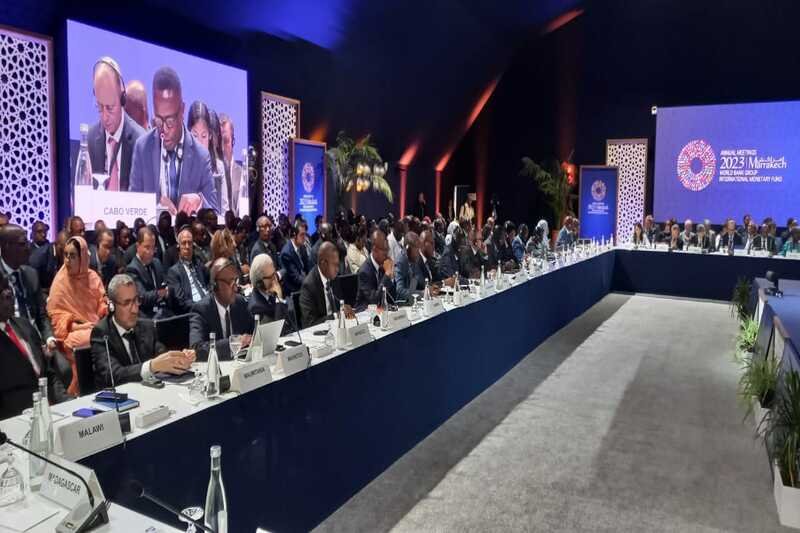
Marrekesk, 10 and 11 October – An Annual Memorandum of African Caucus was delivered to Kristalina Georgieva, Director General of the International Monetary Fund (IMF) on 10 October, and to Ajay Banga, President of the World Bank Group (GBM) on 11 November, by Olav Garcia, Vice Prime Minister of Cape Verde and President of African Caucus 2023, which reflects the harmonised position of Finance Ministers and Governors of Central Banks of the 54 African countries on development finance issues in African economies.
The Memorandum, out of the last African Caucus Meeting, which took place on 6 and 9 June 2023 on Sal/Cape Verde Island, urges the IMF and GBM to:
Ensuring the sustainability of public debt in Africa, urging Brettom Woods institutions to step up support for effective and faster implementation of the Framework Common G20 Debt Treatment including increased technical support for debt restructuring.
On this path African countries requested that short-term loans with high interest be converted into long-term loans with low interest, including debt relief, debt suspension during trading periods and definitive cancellations to countries in debt situation.
The Memorandum also urges the World Bank to add contingent clauses to the State for financing agreements that allow the suspension of debt payments in the event of natural disasters or exogenous shocks that trigger an economic or financial crisis.
In the context of financing via the IMF, African Caucus requests the triplication of concessional funding as well as the increased and effective recanalisation of the IMF's Special Drawing Rights (SDRs), including through Regional Development Banks; and the establishment of a Trust Fund for climate debt trading and SDGs.
The Memorandum also mentions the unlocking of climate and energy financing for Africa, a need of about $2.8 billion, considering a 10% contribution of the value coming from African countries, focused on speeding up the Sharm el-Sheikh Implementation Plan and expecting stronger commitments at COP28 to help bridge funding gaps in African low- and medium-income countries.
Climate and energy financing are complementary and mutually reinforcing and would require balanced levels of support, the President of African Caucus stressed.
The African continent will need substantial investments in the energy sector worth USD 200 billion between 2021 and 2030, i.e. around USD 20 billion a year to ensure access to electricity to more than 600 million people and clean energy to some 900 million people.
The top leaders of the Bretton Woods Institutions (IMFs and WBs) have positively wavered climate finance issues (carbon markets, relief of the debt burden in exchange for climate resilience projects), as new sources of funding for the least polluting and most suffering countries with climate change, in which Mozambique is part; greater access to the Sustainability and Resilience Fund (at this time only Rwanda and Morocco have had access to Africa level), and on the issue of increasing Special Rights of Draw.
In terms of pardoning public debt, Ajay Banga, President of the World Bank Group, referred to the $12 billion disbursed by the WB being invested in concessional mode and another half in donation format that allowed the restructuring of the public debt of Ghana, Eritrea, Chad and Zambia.
The African Caucus was created in 1963 as the "African Group", with the aim of strengthening the voice of African Governors in Bretton Woods (IBW), i.e. the International Monetary Fund (IMF) and the World Bank Group (GBM) on development issues of particular interest to Africa.
The African Caucus meetings took place on 10 and 11 October in Marrakech.